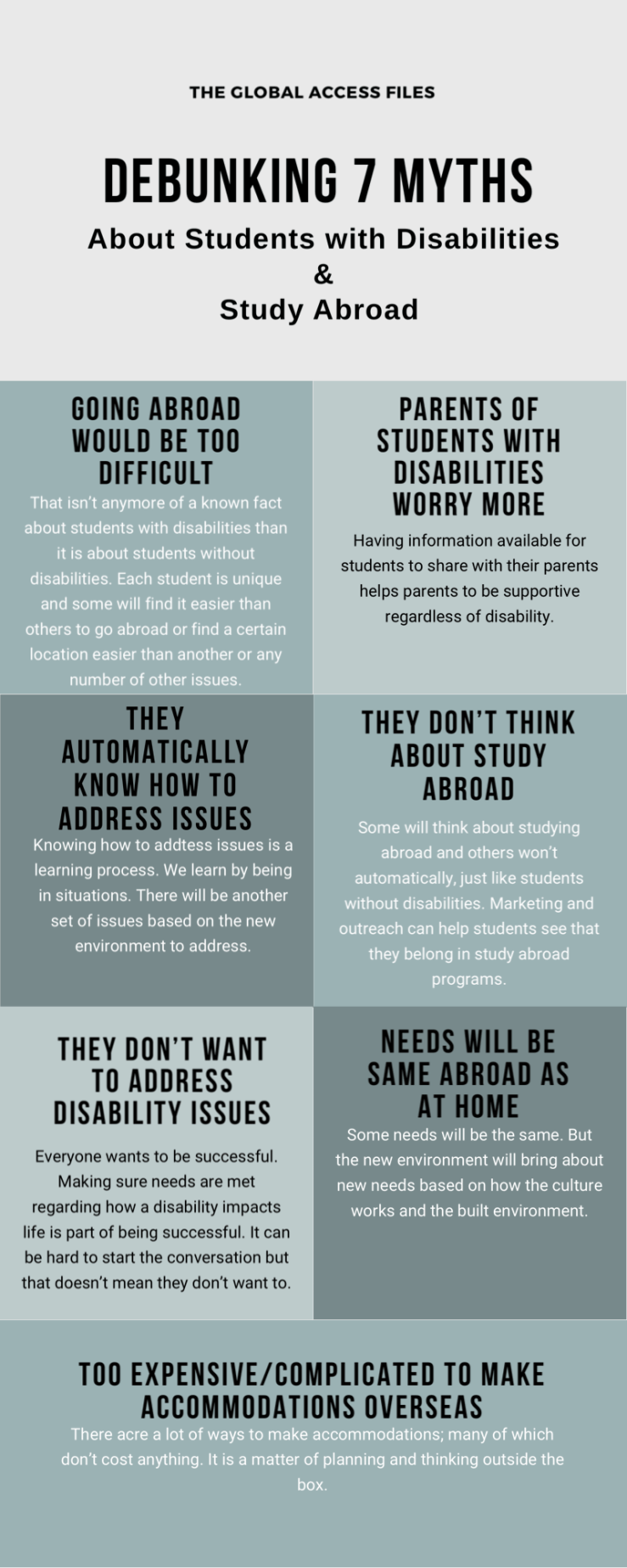
Myths develop most when a topic isn’t well understood. The lack of understanding often comes from a lack of communication about the topic. Myths about people lead to inaccurate assumptions and acting on those assumptions. There are a lot of myths out there about disabled people. I’ve gathered 7 common myths related to people with disabilities and study abroad and debunked them.
Disclaimer: although this is written specifically with study abroad in mind these myths also apply to people with disabilities and general travel/tourism.
Going Abroad Would Be Too Difficult for a Disabled Student
Truth: That isn’t any more a known fact about disabled students than it is of non-disabled students. Each student regardless of disability is unique and some will find it easier than others to go abroad or find a certain location easier than another or any number of other issues. Everyone has their unique circumstances, strengths, and weaknesses. Rather than judge an individual or a whole group of people it is important to get to know them and look for ways to make the situation work. If you go into the situation with the belief that this student has something to gain from going abroad then you will work towards making that happen. If you don’t go in with the belief that this student has something to gain from going abroad then you will work towards making that happen. It’s a choice of perspective.
Parents of Students with Disabilities Worry More Than Parents of Students without Disabilities
Truth: Again, that isn’t any more a known fact about students with disabilities than it is of students without disabilities. Having information available for students to share with their parents helps parents to be supportive of study abroad regardless of disability. Having resources that demonstrate your willingness to work with students with disabilities also helps parents to be supportive. People most often worry when there is a lack of information available to them. That worry can often be mitigated by the provision of information. Throwing your hands up and surrendering to worry is not a good plan whether that worry is whether your child can go abroad, how to facilitate an experience from a professional perspective, or how to make an experience abroad happen from a personal perspective if you have a disability.
Students with Disabilities Automatically Know How to Address Issues
Truth: Knowing how to address issues is a learning process. We learn by being in situations. When you have an initial conversation with a student the situations they will be most prepared to address are the ones they have been in before. However, when we are talking about going overseas there will be another set of issues based on that new environment and how that culture works. A person is going to automatically give information based on their everyday experience in their home environment. For example, I use a wheelchair and get around very independently in my home environment. In order to help me figure out what I need to be successful abroad it is worth realizing that I can be independent in my home environment because I have access to my own car and I know that any place I would go has curb cuts, ramps, and elevators. These are things that are not guaranteed in various countries. A person who may not have gone abroad before may not think to draw that detailed of a picture. Therefore it is worth asking, “What are the things that contribute to you being independent in your day to day life?” From there some of the additional issues that are likely to arise can be addressed.
Students with Disabilities Don’t Think About Studying Abroad
Truth: Just like students without disabilities there are some who think about studying abroad and others who don’t. Just like professionals do outreach to other groups that collectively are underrepresented, doing outreach to students with disabilities goes a long way to helping students who may not already be thinking about it to catch the vision. Some students with disabilities who are thinking about it will step forward and start the conversation. Others are going to want to to see evidence that the professionals are thinking about students with disabilities before they start the conversation about their personal needs.
Students with Disabilities Don’t Want to Address Disability Issues
Truth: Everyone wants to be successful. Most realize that being successful takes effort. Being successful happens when the people in our lives support us in whatever it takes to be successful. For people with disabilities making sure our needs are met in terms of how our disability impacts our lives is part of that. People with disabilities are more likely to participate when they can see those needs will be met. It can sometimes be hard to start the conversation but that doesn’t mean they don’t want to have that conversation.
Students with Disabilities’ Needs Will Be the Same Overseas as They Are at Home
Truth: Just like anyone else some needs are the same regardless of being home or abroad. But being in a new environment will bring about new needs based on how the culture works and the built environment. As previously addressed, professionals need to guide students in thinking about their needs in an environment that isn’t just like home.
It’s Too Expensive or Complicated to Make Accommodations Overseas
Truth: There are a lot of ways to make accommodations; many of which don’t cost anything. It is a matter of planning and thinking outside the box. Many times there are fairly simple solutions that work well for all involved and don’t have added expense. Sometimes there may be an added expense. Either way, it is always best to have an open conversation and be willing to look for solutions that promote inclusion.
Every individual has a responsibility to recognize the myths that lead to inaccurate assumptions and actions. When we are open to conversation attitudes can change, myths can be debunked and we can all reap the benefits of initernational learning experiences.